


Denmark has vowed to defend its territory after President Donald Trump insisted again that the United States should control Greenland, upending a Nato summit in Turkey meant to be a show of strength and unity.
Denmark’s Prime Minister, Mette Frederiksen, said her country is “ready to defend every inch of Nato including our own territory” in the event of an attack, and would rely on Nato allies to honour their commitment to defend each other.
“We hope that all, including all allies, will respect the Greenland people’s right for self-determination,” Ms Frederiksen said ahead of the meeting of Nato leaders. “Greenland is of course not for sale.”
Mr Trump had reopened old wounds on the eve of the meeting by insisting that the United States should control Greenland, a semi-autonomous Danish territory.
Arriving at the summit on Wednesday, Mr Trump said he was “not happy with Nato” for its member nations’ pushback against his earlier efforts to take over Greenland, adding that the territory “is very important for the United States, but it’s not important for Denmark”.
Mr Trump’s renewed interest in Greenland could put at risk the entire future of Nato, which was founded in 1949 to counter the threat to European security posed by the Soviet Union during the Cold War.
The organisation is normally focused on outside threats such as that posed by Russia. It is not designed to deal with threats from within.
Iceland’s Prime Minister, Kristrun Frostadottir, said Greenland “belongs to the people of Greenland”, and called for unity in the face of Russia, which she called “the biggest threat”.
Nato secretary-general Mark Rutte said from Ankara on Wednesday that he believes the United States is fully committed to the alliance. He praised Mr Trump for the series of US strikes on Iran overnight, after Tehran struck three merchant ships in the Strait of Hormuz.

“I think what you did last night was absolutely necessary,” Mr Rutte said to Mr Trump. “It was a very strong response, and I’m with you on this.”
The US strikes, as well as the revoking of a licence allowing Iran to sell its oil on global markets, underscored the fragility of an interim deal to end months of fighting.
Mr Trump said on Wednesday the interim agreement with Iran is “over” after the strikes, but that he will allow talks to continue.
“For me, I think it’s over,” Mr Trump responded when asked about the status of the ceasefire. “It’s just a waste of time dealing with them.”
The summit in Ankara was meant to focus on progress made towards meeting the alliance’s spending targets — something Mr Rutte highlighted by noting numerous countries that are already investing more.

“The commitment is there, no doubt,” Mr Rutte said before chairing the summit, but noted the Trump administration expects European allies and Canada “will equalise their spending with the United States”.
In an attempt last month to mollify the US leader, Mr Rutte went to Washington to hail the “Trump trillion” — the 1.2 trillion dollars that European allies and Canada have added to defence spending since Mr Trump came to power in 2017.
Yet Mr Trump has demanded “loyalty” and branded Nato a “paper tiger” after some allies refused to grant open access to their bases for US forces to attack Iran.
Mr Trump on Wednesday blasted Nato member Spain for its refusals to allow US forces to use its bases to attack Iran, saying it was a “terrible partner in Nato” and renewing his threats to cut off trade with Spain.
As leaders converged on Ankara, Mr Rutte hosted a “big reveal” event to showcase the many deals planned for the increased spending — much of it to be spent on US companies, creating thousands of jobs for Americans.
Nato diplomats and officials had hoped that Mr Trump would take the win, but judging by some of his remarks since arriving in Turkey, they are in for yet another dressing down.
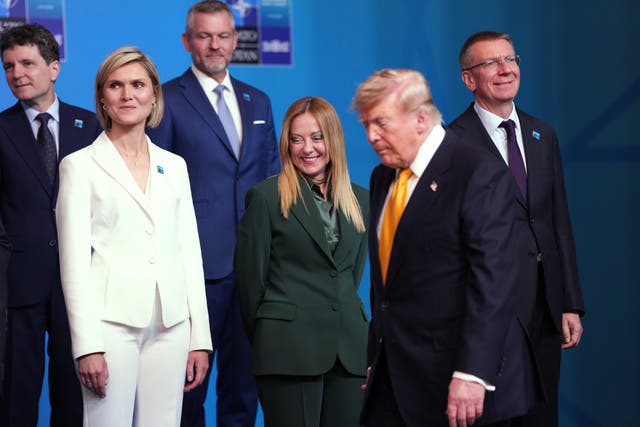
Mr Trump has long argued that the US carries more than its fair share of the defence burden for Nato. At last year’s summit, the allies agreed to invest 5% of their gross domestic product on defence — 3.5% on their defence budgets and 1.5% on infrastructure so troops and equipment can move faster in times of conflict.
Yet new figures released by Nato on Tuesday showed that Slovenia, Belgium, Spain and the Czech Republic could be in hot water with the Trump administration as they struggle to meet the alliance’s old spending target of 2% of GDP.
The Trump administration wants to see a more lean and lethal “Nato 3.0”, with Europe taking responsibility for its own security, including Ukraine, with conventional weapons while America would continue to provide its nuclear umbrella.
However, the Pentagon has launched a six-month review of US military presence in Europe, leaving allies to seek clarity on just how deeply Mr Trump intends to cut US force numbers.
President Volodymyr Zelensky made a fresh appeal on Tuesday for Ukraine to be allowed to join the alliance, saying Ukrainian armed forces are highly experienced and would only boost Nato’s defence capabilities.
Mr Zelensky highlighted Ukraine’s adaptability and its ability to strike deep inside Russia, hit Moscow’s oil refineries and other energy targets. He said Ukraine’s armed forces are “eliminating” on average 30,000 Russian troops every month.

Concern has been mounting among some northern, central and eastern European countries that Russia might be preparing a hybrid attack — a combination of conventional warfare with tactics such as cyber attacks — on the continent as President Vladimir Putin struggles to secure victory in Ukraine.
US senator Jeanne Shaheen, one member of a congressional delegation attending the Nato summit, said at a news conference on Wednesday that she hoped there would be a “recommitment” to Ukraine, and that the momentum on the battlefield favoured Kyiv.
“We need to do everything possible to ramp up pressure on Russia to come to the table,” she said.
As the summit ended, President Trump said the US will give a licence to Ukraine to manufacture Patriot air defence systems to help counter Russian missile attacks, a huge coup for Ukraine which has badly needed the technology for the war.
“We’ll give them the right to make Patriots. We’ll show them how to do it,” Mr Trump said as he met Mr Zelensky. “I think they can produce them pretty quickly.”
Patriots are expensive, in high demand and take a long time to produce. Mr Zelensky has for years been asking for more of them, and more recently for a licence so that Ukraine can manufacture its own.
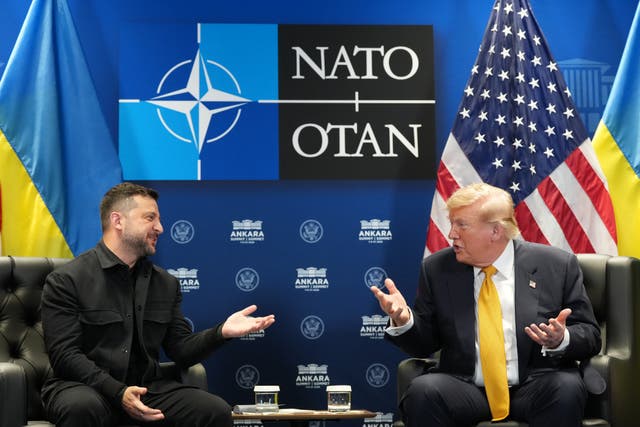
The tone of Mr Trump’s meeting with the Ukrainian leader was a break from earlier encounters which ended in acrimony, and Mr Trump praised Mr Zelensky’s willingness to reach a deal on ending the fighting in Ukraine.
He said the Ukrainian president has “done an amazing job” and “been very effective” in the war.
“We’ve actually developed a good relationship. It’s hard to believe,” Mr Trump said, adding he believed a deal on ending the war was on the horizon and that the US would “work on some kind of security package” to provide to Ukraine.
In a declaration following Wednesday’s summit, Nato leaders pledged to provide Ukraine with 80 billion dollars to help meet its defence needs this year and next, noting “the long-term threat Russia poses to Euro-Atlantic security”.